

The Work Between Findings and Change

A quality review can make the strengths and gaps in teacher preparation visible. But identifying what needs to improve does not, by itself, change how future teachers are prepared.
That requires a different set of decisions. What should change in the program's systems and expectations? What should faculty, clinical supervisors, and mentor teachers do differently? And what will candidates experience, practice, and demonstrate as a result?
Across ten recent Strategic Action Planning engagements in Michigan and Delaware, EdPrep Partners has been working with educator preparation programs (EPPs) to translate review findings into focused priorities and implementation plans. Early learning is helping us better understand what makes improvement actionable – and why the work following a review matters as much as the findings themselves.
Defining Quality Is Only the Beginning
High-quality teacher preparation depends on connected systems and practices. Candidate expectations, coursework, clinical experiences, teacher educator practices, coaching, assessment, and partnerships must work together to develop candidates toward readiness to teach.
The EdPrep Performance Framework defines quality across four areas: Program Leadership and Continuous Improvement, Candidate Preparation and Development, Teacher Educator Practices, and District and Program Partnerships. The 14 Levers for Quality Teacher Preparation help programs identify the practices and structures most important to strengthen. They are not 14 simultaneous initiatives or isolated approaches.
Programs rarely begin from scratch. Many have existing frameworks, promising practices, established partnerships, and committed educators. Improvement often involves strengthening what is inconsistent, connecting what has been developed separately, and making deliberate decisions about where change will matter most.
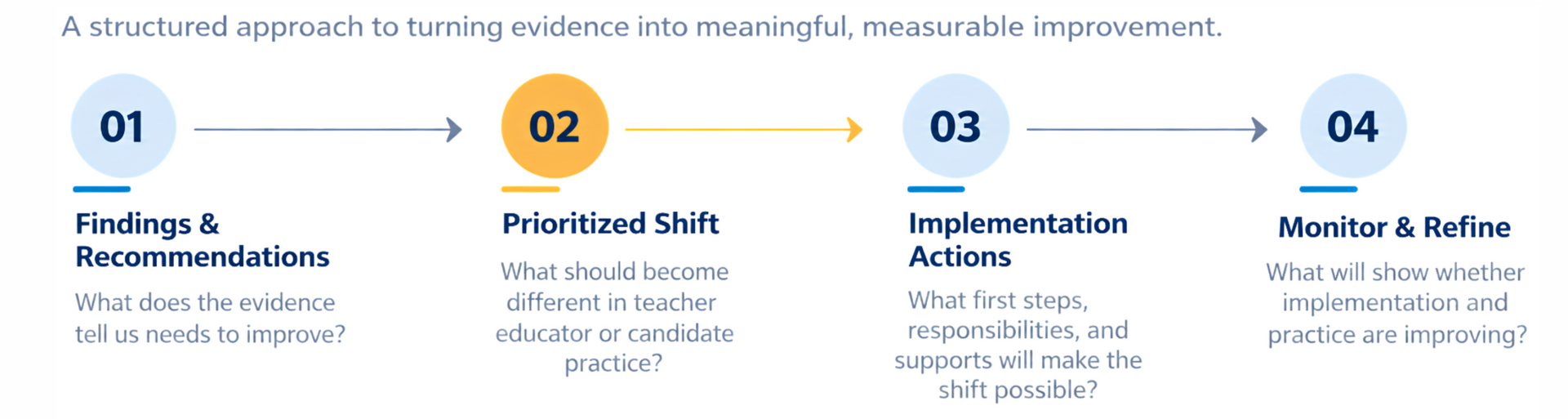
As we explored in The Prioritization Imperative, a comprehensive understanding of quality must be accompanied by the discipline to focus. The next challenge is translating those priorities into meaningful changes in preparation.
One Priority, Three Connected Shifts
A recommendation identifies what should improve. A prioritized shift defines what must become different in practice.
We are finding it useful to examine prioritized shifts at three connected levels: program systems, teacher educator practice, and candidate development.
- At the program level, the question is what expectations, structures, processes, or supports must change to make stronger preparation possible.
- At the teacher educator level, the question is what faculty, clinical supervisors, and mentor teachers must do differently in how they teach, model, coach, assess, and support candidates.
- At the candidate level, the question is what candidates must experience, practice, refine, and demonstrate as they develop toward readiness to teach.
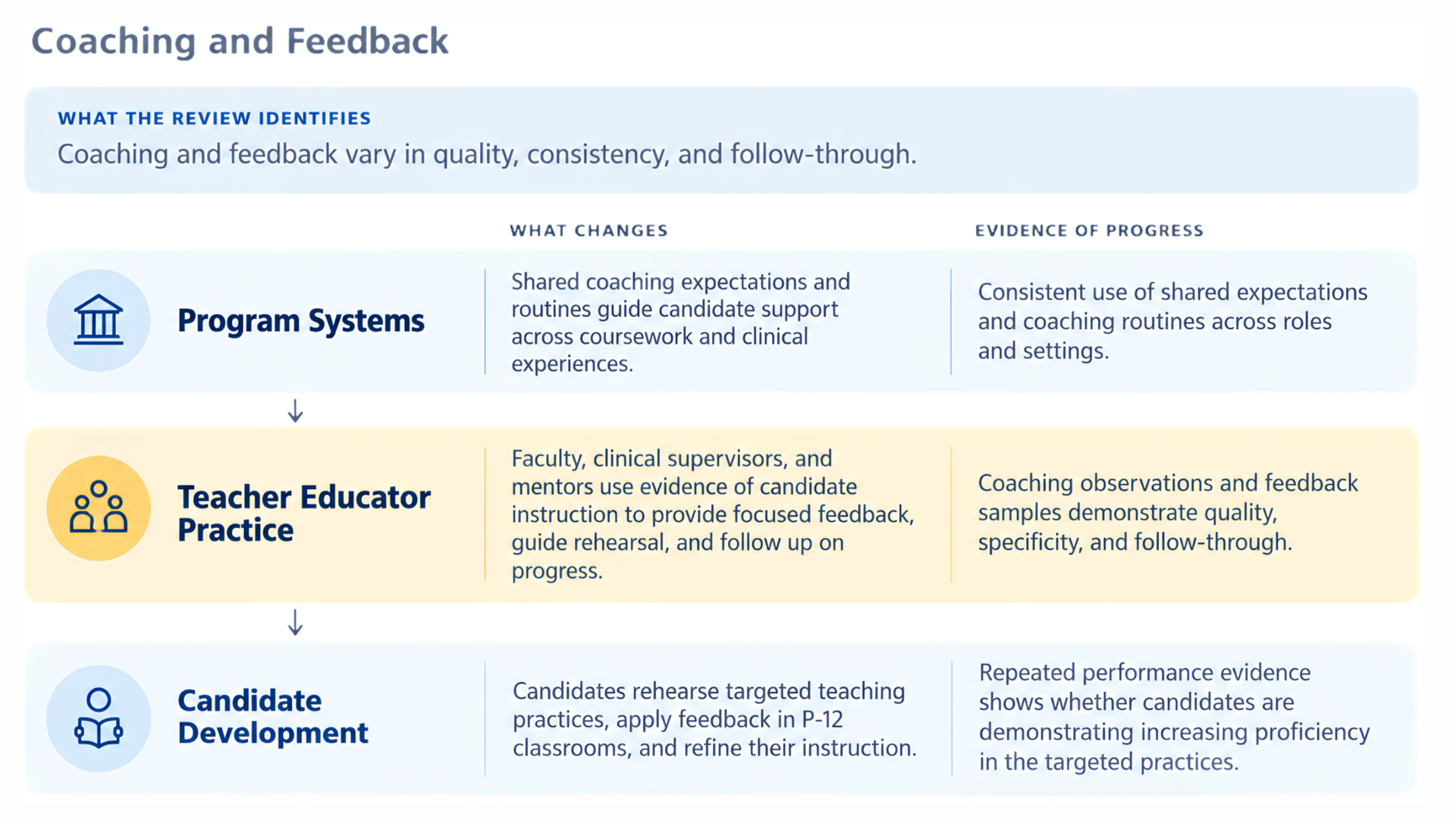
Consider a recommendation to strengthen coaching and feedback. A program might establish shared expectations and structured coaching routines across coursework and clinical experiences. But the consequential shift is not simply having those structures in place. Supervisors must consistently use evidence of candidate instruction to provide focused feedback, guide rehearsal, and follow up. Candidates, in turn, need opportunities to apply that feedback, refine targeted teaching practices, and demonstrate stronger performance.
These are connected changes, not three unrelated initiatives. Program systems should enable stronger teacher educator practices. Those practices should improve candidates' developmental experiences. And evidence of candidate performance should inform further decisions about preparation.
Revising an observation tool, providing professional development, or completing a new framework can help make these changes possible. None independently establishes that preparation has improved.
A useful prioritized shift therefore needs a clear connection to candidate readiness, enough specificity to guide implementation, and observable expectations that allow programs to examine whether meaningful change is occurring.
Choosing What Matters Also Means Choosing What Comes First
Changes across these levels are interconnected, but they do not necessarily happen at the same time.
More consistent coaching may require shared performance criteria. Stronger candidate progression decisions may depend on a clear developmental trajectory. Better data routines may require faculty and supervisors to interpret candidate evidence using compatible expectations.
Across current implementations, teams are refining existing frameworks, identifying observable instructional look-fors, and connecting developmental expectations to coursework, clinical practice, coaching, and assessment.
The sequence matters. One program may need to establish shared expectations before improving its coaching model. Another may already have strong criteria and be ready to pilot a structured coaching routine. A focused pilot can also help a program test an approach and refine the broader system while implementation is underway.
There is no universal starting point. What matters is identifying what can begin now, what depends on earlier decisions, and what should wait.
This requires attention to institutional authority, faculty capacity, existing initiatives, and partnerships with P-12 schools. Sequencing helps programs make consequential changes without asking faculty and supervisors to pursue every improvement at once.
What Ten Planning Engagements Are Teaching Us
Early participant feedback suggests that Strategic Action Planning is helping teams move from broad recommendations toward clearer priorities and initial implementation decisions.
Across ten EPP engagements, 63 participants completed post-session surveys. When each institution is weighted equally, favorable responses averaged:
- 97% reported greater clarity about the prioritized practices their teams would pursue.
- 97% agreed that Strategic Action Planning and related activities were valuable for planning and implementation.
- 91% reported greater clarity about initial actions, responsibilities, timelines, and evidence needed to begin implementation.
These findings reflect participants' perceptions immediately following planning. They are not yet evidence that teacher educator practices or candidate performance have improved.
The results also varied across institutions. At one EPP, participants reported substantially less clarity about initial implementation actions, even as they recognized value in the planning process. That distinction matters: agreeing on a direction does not necessarily mean a team is ready to carry it out.
Participants valued protected time for decision-making, concrete examples and starting drafts, and clearer next steps. They also identified competing demands, limited capacity, unresolved questions about findings, and the challenge of engaging colleagues beyond the initial planning team.
Four enabling conditions continue to surface: commitment, capacity, clarity, and collaboration.
Leaders must authorize and support improvement. Faculty and supervisors need time and resources to develop and apply new practices. Teams need shared expectations and a clear understanding of the intended changes. And the people responsible for implementation must have meaningful opportunities to shape and own the work.
These conditions are especially important when improvement requires decisions across colleges, departments, administrative offices, and P-12 partnerships.
Supporting the Shift, Not Just the Plan
Moving from planning to implementation requires support that is specific to the change a program is trying to make.
Programs do not necessarily need another set of disconnected tools, meetings, or initiatives. They need practical assistance that builds on existing work, strengthens the people responsible for preparation, and helps new expectations become part of regular practice.
One principle emerging from our work is Draft first. Refine together. Strong starting drafts, examples, and tools can reduce the time faculty spend creating materials from scratch and allow more attention to the decisions that matter.
But a starting draft should accelerate a program's thinking, not predetermine its decisions. Programs need to examine proposed approaches against their existing strengths, context, and priorities, and develop ownership of what they ultimately implement.
Teacher educator development is especially consequential. Introducing a new framework or coaching protocol is insufficient if faculty and supervisors do not have opportunities to understand, practice, apply, and refine the expectations it establishes.
That may require modeling effective teacher educator practices, rehearsing feedback conversations, calibrating the interpretation of candidate performance, piloting revised routines, and examining evidence from their use.
For state agencies strengthening their approaches to educator preparation reviews, this distinction has important implications. A review can identify where quality needs to improve, but an improvement plan alone cannot ensure that changes take hold. Programs also need a practical pathway for implementing the recommended changes, accessing relevant support, and examining evidence of progress.
The work must ultimately become part of how programs operate—not remain dependent on a planning team, temporary initiative, or external provider.
Follow the Evidence Into Practice
The next test is whether prioritized shifts become visible in preparation.
Early milestones may include completed frameworks, clarified expectations, professional development, new protocols, or pilot activities. These are important steps. But they provide different evidence than actual changes in teaching, coaching, and candidate performance.
- At the program level, we need to know whether intended structures and routines are being used, where implementation is occurring, and whether the program is building the capacity to sustain them.
- At the teacher educator level, we need evidence that faculty, clinical supervisors, and mentor teachers are consistently enacting stronger practices. Are they modeling more effectively? Providing more specific and actionable feedback? Facilitating purposeful rehearsal? Following up on candidate progress?
- At the candidate level, we need to examine what candidates are actually experiencing and demonstrating. Are they receiving the intended developmental opportunities? Are they applying feedback and refining their teaching? Does repeated performance evidence show increasing proficiency in the instructional practices they will need as teachers?
Evidence at one level does not establish progress at the next.
A program may implement a new coaching structure without yet improving the quality of coaching. More consistent coaching does not, by itself, demonstrate that candidates are better prepared. Each conclusion requires appropriate evidence.
This is why monitoring must be part of implementation rather than something reserved for its conclusion. Programs need recurring opportunities to examine what is changing, identify where additional support is needed, and refine the work.
The goal is not simply to demonstrate that a plan was implemented. It is to determine whether changes in program systems and teacher educator practices are strengthening candidate development and readiness over time.
When Priorities Become Practice
The value of an improvement plan is not the number of recommendations it addresses or the tasks it completes. It is what changes because of it.
Credible review findings establish a starting point. Focused priorities identify what matters most. Deliberate sequencing, institutional ownership, and sustained support create the conditions for implementation.
But the most consequential changes become visible in how teacher educators prepare candidates and what candidates are increasingly able to demonstrate.
That is the work between findings and change.
Stay Connected
If you're interested in learning more, exploring collaboration or technical assistance, or just want to catch up, we’d love to connect:

About EdPrep Partners
Elevating Teacher Preparation. Accelerating Change.
EdPrep Partners is a national technical assistance center and non-profit. EdPrep Partners delivers a coordinated, high-impact, hands-on technical assistance model that connects diagnostics with the support to make the changes. Our approach moves beyond surface-level recommendations, embedding research-backed, scalable, and sustainable practices that most dramatically improve the quality of educator preparation—while equipping educator preparation programs, districts, state agencies, and funders with the tools and insights needed to drive systemic, lasting change.