
Alignment Starts in Preparation
The First Year Should Not Require Starting Over
A new teacher should not arrive at a school and discover that the materials, instructional expectations, coaching language, and routines that will shape their daily work are largely unfamiliar.
Yet that transition can still happen even when both the educator preparation program and the P-12 system have invested deeply in quality.
A program may have strong coursework, committed faculty, meaningful clinical experiences, candidate assessments, and clear expectations for teaching. A district may have invested in high-quality instructional materials, evidence-based literacy and mathematics practices, coaching, professional learning, observation and feedback, and data routines.
Both can be strong.
And candidates can still experience a disconnect between them.
The issue is not whether preparation should mirror every district. It should not. The issue is whether candidates experience a developmental throughline between what they are prepared to know and do and the instructional environments they enter.
When that throughline is weak, new teachers are asked to make too many of the connections themselves. They may have to learn a new language for practices they already prepared for, reconcile competing expectations, work with unfamiliar instructional materials, or adjust to feedback systems disconnected from what guided their development during preparation.
If alignment matters once educators enter classrooms, it should not begin when they are hired.
It should begin in preparation.
Across the country, that opportunity is becoming increasingly visible. States are carrying evidence-based literacy and mathematics expectations further into preparation. District investments in high-quality instructional materials are raising new questions about curriculum readiness. Residencies and other clinical models are creating deeper EPP and P-12 partnerships. States and programs are paying greater attention to mentor teachers, practice-based development, candidate performance, and the evidence used to determine readiness.
Together, these shifts point toward a larger opportunity: strengthen the alignment from preparation to practice so candidate readiness becomes more reliable, not more dependent on where a candidate happens to encounter the right practice, teacher educator, clinical setting, or support.
Alignment Does Not Require Uniformity
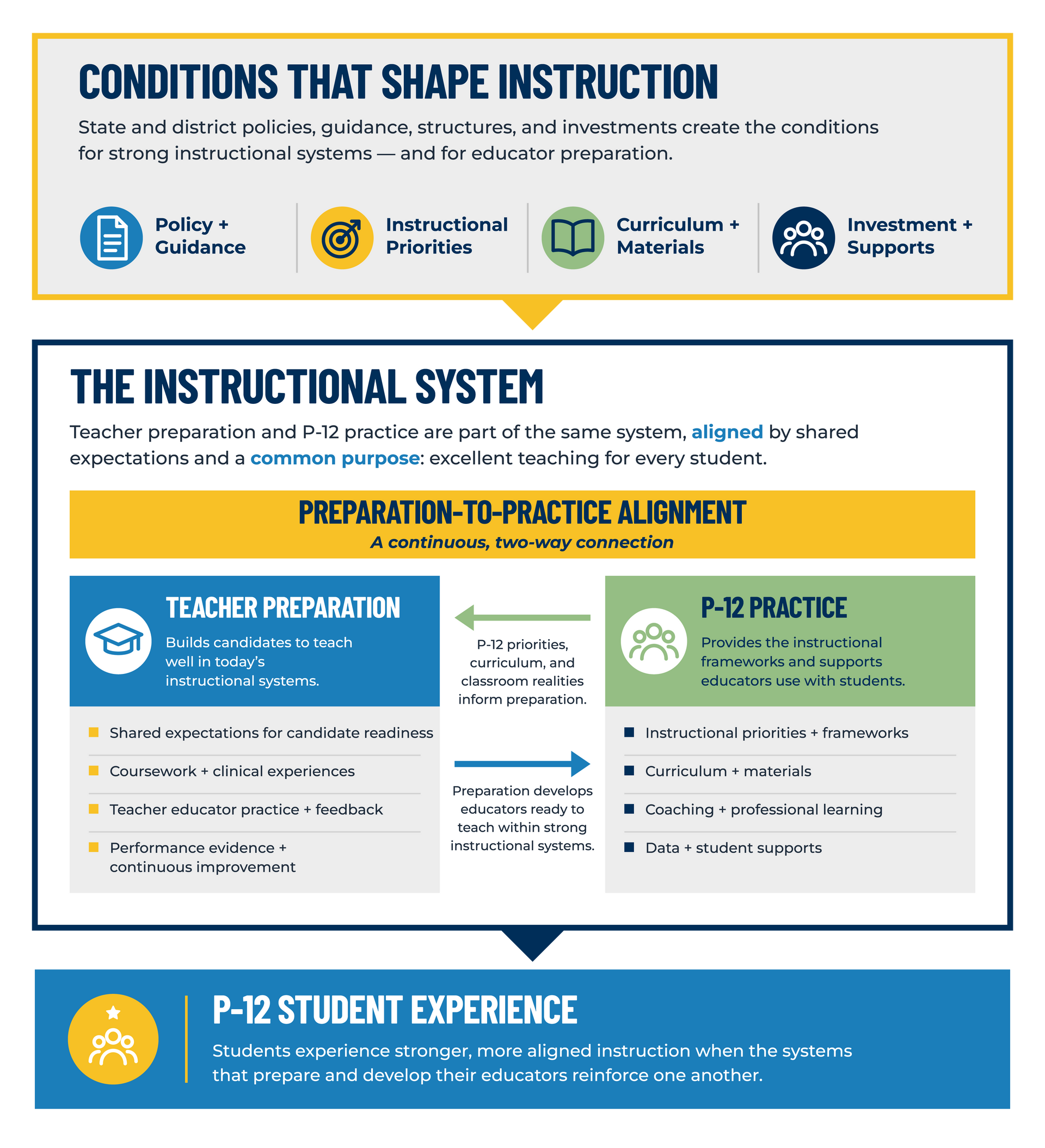
We think of preparation-to-practice alignment as the intentional connection among the people, practices, and systems that prepare candidates to teach and the instructional expectations and supports they encounter as they enter the profession.
The important word is connection.
Alignment does not require uniformity.
Educator preparation programs serve candidates who enter different schools, districts, communities, curricula, and instructional contexts. Programs should not simply adopt every district observation tool, prepare candidates for one employer, or change their approach each time a local initiative shifts.
Preparation has its own developmental responsibility.
Programs must help candidates build content knowledge, instructional practice, professional judgment, and the ability to respond effectively across learners and contexts. They need developmentally appropriate expectations for what candidates should know and be able to do, not wholesale adoption of tools designed to evaluate experienced teachers.
At the same time, P-12 context matters.
Programs should understand the instructional frameworks candidates encounter in clinical placements, the curricula used by major partners, the coaching and feedback language candidates hear in schools, and the expectations new teachers will face. Those expectations can inform candidate development while preserving the distinct role of preparation.
The goal is not to make every program and district look the same.
The goal is to ensure candidates are not left to figure out how the pieces fit together on their own.
Alignment Has to Reach Candidate Experience
Programs rarely begin from zero.
Most already have meaningful strengths across coursework, clinical experiences, assessments, teacher educators, partnerships, and data systems. The opportunity is to make those parts work together more intentionally around candidate development and readiness.
That starts with four connected questions.
Define What Readiness Requires
Candidates, teacher educators, and P-12 partners need a clear picture of what candidates are developing toward.
What should candidates know and be able to do by program completion? What should that performance look like earlier in preparation? What should candidates demonstrate before assuming greater instructional responsibility?
Broad standards and program values provide important direction, but they become more useful when translated into shared expectations, observable criteria and look-fors, and an explicit candidate developmental trajectory.
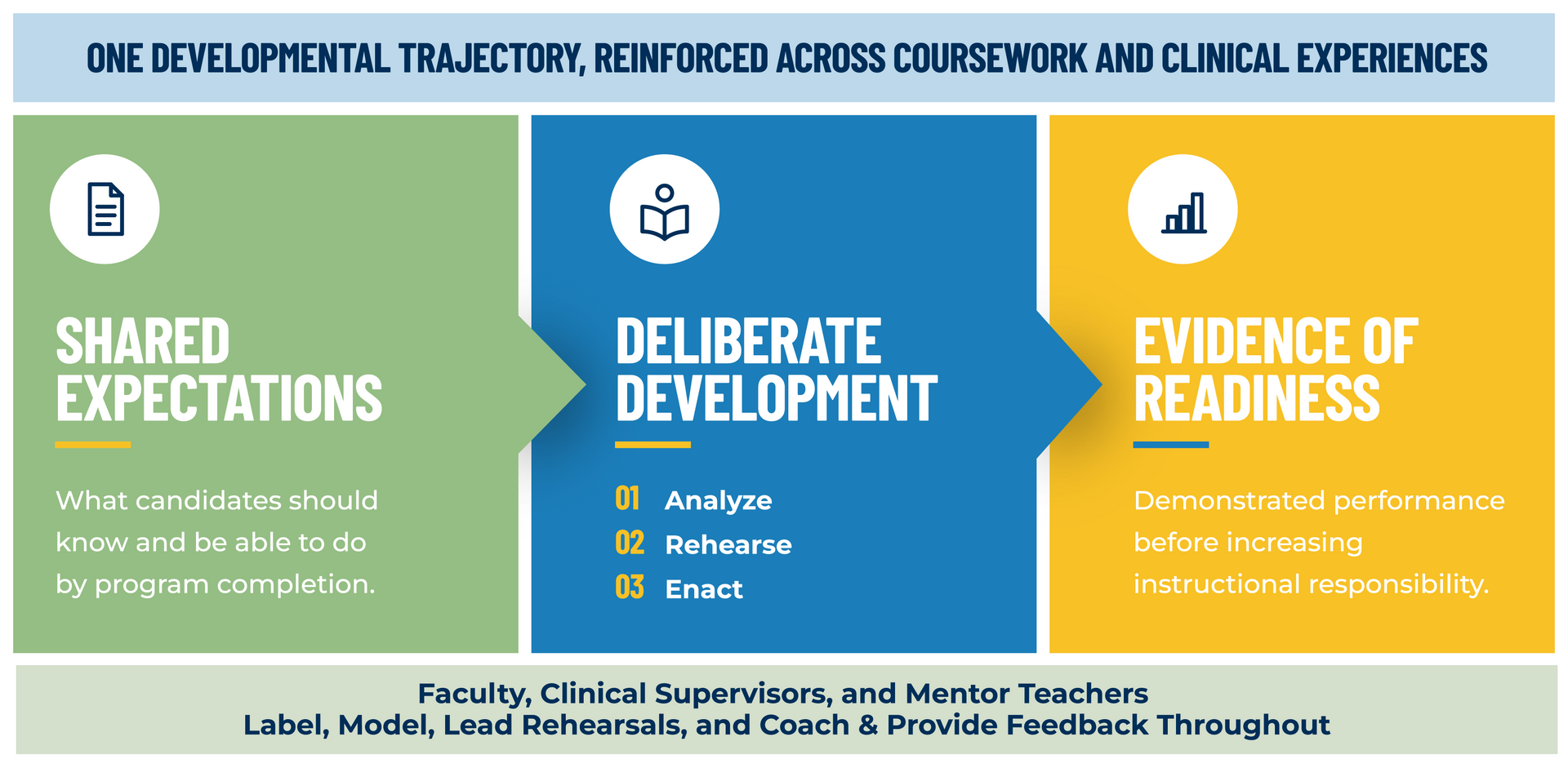
That trajectory gives the rest of preparation something common to work from. Coursework can deliberately develop the practices. Clinical experiences can provide increasingly authentic opportunities to enact them. Coaching and feedback can reinforce them. Performance evidence can show whether candidates are progressing toward readiness.
A common direction does not eliminate professional judgment.
It makes candidate development more intentional.
Develop Candidate Practice and Performance
Knowing about teaching is not the same as being able to teach.
Candidates need repeated opportunities to study strong practice, see it made visible, analyze instructional decisions, rehearse consequential teaching moves, enact those practices with P-12 students, receive high-quality feedback, refine, and try again.
That developmental progression sits at the center of practice-based preparation.
Across our work with educator preparation programs, a recurring opportunity is to move from candidates primarily learning about teaching toward being deliberately developed to perform it.
Coursework and clinical experiences should build on one another so candidates do not move directly from discussion or lesson planning into complex classroom enactment without supported practice in between.
Candidates should experience preparation as a developmental trajectory, not a collection of courses and placements.
This is also why alignment cannot be reduced to content insertion.
Adding a state-required literacy module, mathematics training, or curriculum resource to an existing course does not by itself strengthen readiness. Candidates need opportunities to use that knowledge in analysis, planning, rehearsal, enactment, feedback, assessment, and clinical practice.
The question is not simply: Was it covered?
The stronger question is: How was the candidate developed to use it?
Strengthen the People Who Develop Candidates
Candidate development does not happen through program structures alone.
It happens through people.
Faculty, clinical supervisors, mentor teachers, field instructors, coaches, and other teacher educators shape what candidates learn through what they model and label, what they ask candidates to practice, the evidence they notice, the feedback they provide, and the next steps they help candidates take.
That is why teacher educator practice is not peripheral to program quality. It is one of its primary drivers.
Across all five Michigan EPP Deep Dives, coaching and feedback surfaced as an opportunity for stronger quality, consistency, or developmental use across coursework and clinical experiences.
Mentor teachers matter for the same reason. They are not simply placement hosts. They are teacher educators whose practice influences what candidates see, rehearse, enact, receive feedback on, and learn to improve.
Alignment does not require every teacher educator to teach identically. It does require the people responsible for candidate growth to understand what candidates are developing toward, what quality looks like at different points in the trajectory, and how their role contributes to that development.
Reliable candidate readiness requires reliable candidate development.
Use Evidence to Keep Improving Preparation
Candidate readiness should be visible before candidates are asked to assume greater responsibility.
Performance evidence can help programs determine whether candidates are ready for what comes next and identify what additional practice, feedback, coaching, or support is needed when they are not yet meeting expectations. Progression should increasingly reflect demonstrated performance, not only course completion, credit hours, clinical hours, or the passage of time.
But candidate evidence should do more than support individual progression decisions.
It should help the program learn.
If candidates repeatedly struggle with an instructional practice, programs should be able to examine where it was introduced, how candidates practiced it, what feedback they received, how teacher educators supported it, and whether clinical experiences provided sufficient opportunities to refine it.
Data becomes useful when it changes what happens next.
That is why strong data routines move beyond reporting. They bring the right people together around focused questions, examine evidence from multiple sources, identify specific actions, assign ownership, and return to the evidence to determine whether implementation strengthened candidate development.
The goal is not more data. It is better preparation.
P-12 Partnerships as Candidate-Development Partnerships
Alignment also changes what partnership means.
EPP and P-12 partnerships often carry significant operational responsibilities. Partners identify placements, establish agreements, communicate about candidates, coordinate clinical experiences, and connect preparation to workforce needs.
Those functions matter.
But a placement relationship is not automatically a candidate-development partnership.
Strong partnerships make candidate development shared work. They clarify what candidates need to experience, which roles are responsible for supporting that development, how clinical sites and mentor teachers are selected, what evidence partners will examine together, how concerns will be addressed, and how decisions will be followed across EPP and P-12 settings.
Our partnership work increasingly focuses on this shift: moving beyond partnership primarily as placement, affiliation, communication, or goodwill toward structures that actively support candidate development.
That changes how programs think about clinical placement itself.
Availability, geography, and logistics will always matter. But so should the developmental opportunity a placement provides.
Does the candidate have access to strong instruction? Is the mentor equipped to model and coach? Will the candidate work with the content, curriculum, and instructional practices the program is developing? Is there a clear connection between coursework and what candidates are being asked to enact? Will they receive feedback that reinforces their developmental priorities?
Placement decisions should increasingly reflect those questions.
A clinical placement is not simply where preparation happens. It is part of how preparation happens.
States Are Moving Alignment Upstream
States are beginning to make these connections more explicit.
Texas provides a current example.
Through House Bill 2 and the PREP framework, the state is linking preparation pathways, preservice practice, district partnerships, mentor support, instructional content, and funding. Texas has also moved Reading and Mathematics Academy content further into preparation, with stated aims that include reducing duplicative training after hire and better aligning candidate learning with district expectations and student needs.
That policy direction is consequential.
Instructional priorities that might once have been addressed primarily through professional learning after employment are increasingly expected to shape initial preparation.
The implementation challenge is equally instructive.
Deans for Impact found that required content integration was the most frequently cited implementation challenge among surveyed Texas EPPs. The work involves more than finding room in a course. Programs described mapping existing candidate learning, revising coursework, and connecting those changes to meaningful field and clinical experiences.
Delaware offers a different example.
Statewide Science of Reading expectations have been connected to preparation reviews, evidence from coursework and clinical practice, prioritized recommendations, Strategic Action Planning, targeted technical assistance, and ongoing implementation support. The focus is not simply whether evidence-based literacy content appears somewhere in preparation. It is whether statewide expectations become candidate knowledge, practice, feedback, and readiness across the preparation experience.
These approaches differ in design and context.
The broader direction is similar: instructional priorities that shape P-12 classrooms are increasingly reaching upstream into how future educators are prepared.
From Policy to Implementation
Policy can create direction.
A framework can create clarity.
A program review can identify where greater alignment would add value.
None changes candidate experience by itself.
Implementation is where alignment becomes real.
It becomes real when an assignment changes so candidates have to rehearse rather than only describe a practice. When a clinical observation focuses on the same candidate expectation developed in coursework. When a mentor teacher receives the tools and development needed to provide actionable feedback. When faculty and supervisors calibrate around evidence of candidate performance. When a data routine identifies a recurring gap and the program changes what candidates experience as a result.
This is why alignment cannot be treated primarily as a compliance exercise.
Strong implementation requires programs and partners to understand preparation in practice, identify the few shifts most likely to strengthen candidate readiness, support the people responsible for implementing those shifts, monitor whether implementation is actually occurring, and refine based on evidence.
That also has implications for states.
If states move expectations upstream into educator preparation, implementation support must move upstream too.
Texas EPP leaders have already identified technical assistance and networked learning as important supports for translating new requirements into practice.
The work does not end when a new expectation is adopted.
That is when implementation begins.
Practice Should Inform Preparation, Too
Preparation-to-practice alignment should work in both directions.
States, schools, and districts can help educator preparation programs understand instructional expectations, workforce needs, curriculum use, and the realities beginning teachers encounter.
Preparation programs can use that context to strengthen candidate development.
Then evidence from candidates and graduates should travel back.
Where are candidates consistently demonstrating readiness? Where do they need additional development? Which clinical settings appear to provide stronger developmental experiences? Where is feedback inconsistent? What are graduates encountering during their first years of teaching? What do school leaders, mentors, graduates, and candidates see that the preparation program should understand?
No single outcome can answer those questions. Early-career performance and retention are shaped by school leadership, working conditions, curriculum, induction, compensation, student needs, and many other factors beyond preparation.
But those realities do not make evidence from practice irrelevant.
They make thoughtful interpretation essential.
A stronger preparation-to-practice system uses evidence from both sides of the transition to learn, adjust, and improve.
The transition into teaching should not be the end of the feedback loop. It should strengthen it.
Alignment Starts in Preparation
Every child deserves an excellent educator.
Preparing educators to enter classrooms ready to teach well takes more than strong coursework, a meaningful clinical experience, a quality mentor teacher, or a clear assessment in isolation.
It takes people, practices, and systems designed to work together.
It takes shared expectations for readiness, a deliberate candidate developmental trajectory, practice-based experiences, teacher educators prepared to model and coach, P-12 partnerships that share responsibility for candidate development, and evidence that helps programs keep getting better.
And it requires a stronger connection between those preparation experiences and the instructional environments candidates ultimately enter.
Alignment does not require uniformity.
It requires intentionality.
When preparation and practice reinforce one another, new teachers do not have to reconstruct what quality teaching means at every transition. They enter classrooms with a stronger foundation and continue developing from it.
If we want stronger, more aligned instructional experiences for P-12 students, we need stronger alignment in how educators are prepared and developed to teach well.
Alignment should not begin at induction. It starts in preparation.
Stay Connected
If you're interested in learning more, exploring collaboration or technical assistance, or just want to catch up, we’d love to connect:

About EdPrep Partners
Elevating Teacher Preparation. Accelerating Change.
EdPrep Partners is a national technical assistance center and non-profit. EdPrep Partners delivers a coordinated, high-impact, hands-on technical assistance model that connects diagnostics with the support to make the changes. Our approach moves beyond surface-level recommendations, embedding research-backed, scalable, and sustainable practices that most dramatically improve the quality of educator preparation—while equipping educator preparation programs, districts, state agencies, and funders with the tools and insights needed to drive systemic, lasting change.