

The Preparation Side of Accountability
Accountability Must Lead to Improvement
States spend considerable time measuring school performance, identifying where students are not being served well, and determining what happens next.
In its recent series, State K-12 Accountability Systems: What's Working, What Isn't, Bellwether raises an important challenge: identifying underperformance is only the first step. States also need the systems, resources, and capacity to support meaningful improvement.
We agree. And we believe this conversation must extend to educator preparation.
States approve and monitor educator preparation programs, establish standards, collect performance data, and enforce requirements. These responsibilities protect the public and establish expectations for preparation quality.
But accountability should also help programs understand how well they are preparing future teachers, identify the changes that matter most, and build the capacity to implement them.
That requires more than better ratings or additional reviews.
Identification is not diagnosis. And diagnosis is not an improvement.
All three are necessary, and each requires a different kind of work.
A Rating Is Not a Diagnosis
Licensure examination results, completion rates, employment outcomes, and other accountability indicators help states identify where closer attention may be needed.
But they cannot, on their own, explain why a program is performing as it is or which changes would most strengthen candidate readiness.
Even a comprehensive review can fall short.
A program may document evidence-based instructional practices in its syllabi without consistently providing candidates opportunities to rehearse them. Clinical supervision requirements may be met without candidates receiving timely, actionable feedback. Assessment data may be collected without informing changes to coursework or candidate supports.
A strong diagnostic must examine how preparation actually operates.
At EdPrep Partners, Program Performance Reviews examine artifacts, direct observations, candidate work, performance data, and stakeholder experiences. Expert review teams look for representative patterns, verify findings across multiple sources, and examine how program structures and teacher educator practices influence candidate development.
The EdPrep Performance Framework provides a common reference across program leadership and continuous improvement, candidate preparation and development, teacher educator practices, and district and program partnerships.
The goal is not a longer report. It is a reliable explanation of what is happening, why it matters, and where the greatest opportunities for improvement exist.
A diagnostic should help leaders understand the problem well enough to make better decisions about what to change.
Compliance Correction and Quality Improvement Are Related, but Different
State accountability systems also need to distinguish between correcting regulatory deficiencies and strengthening program quality.
Both matter. Neither should replace the other.
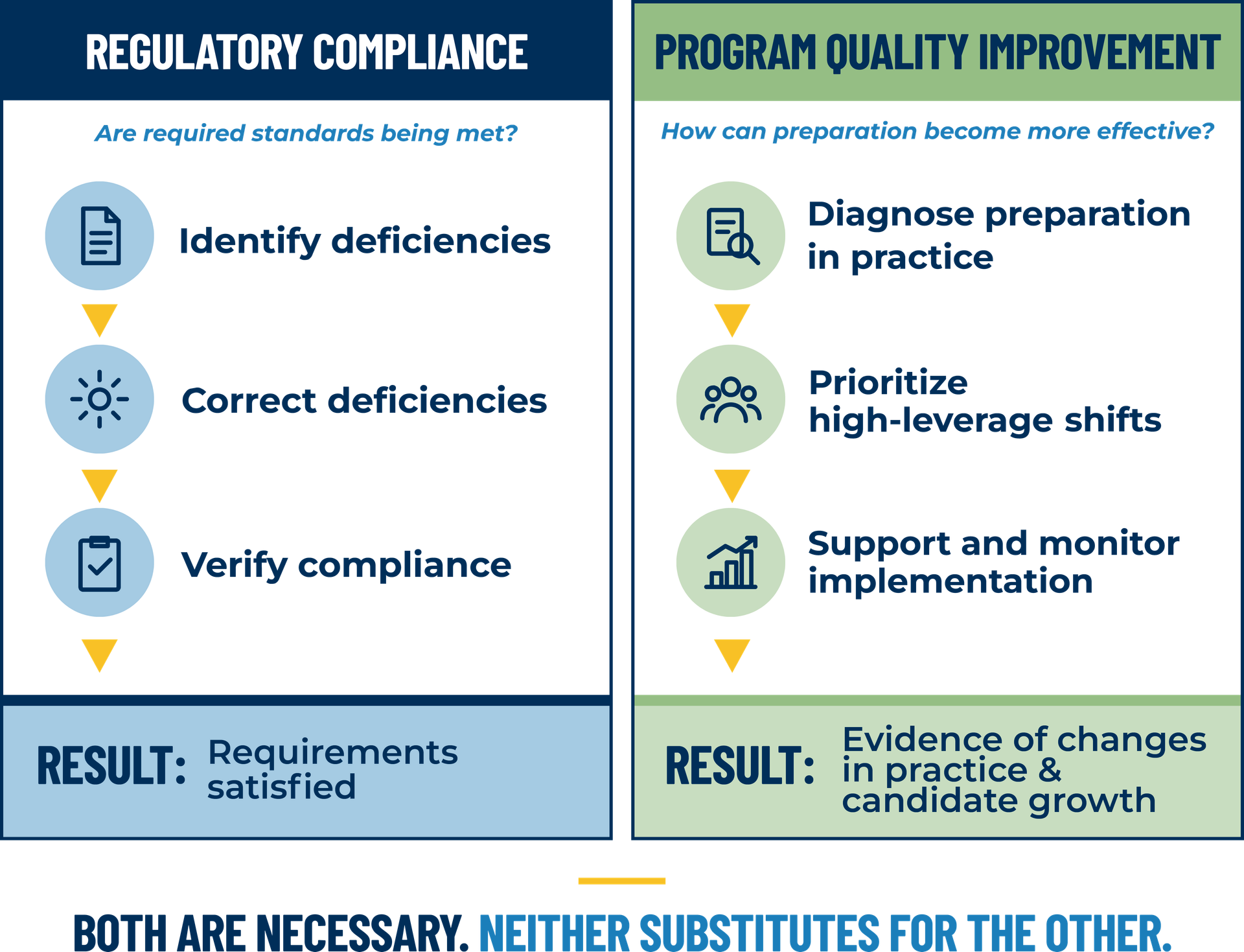
Consider clinical supervision. A state may require a specified number of observations, documented feedback, and evidence that candidates receive appropriate supervision.
If a program fails to meet those requirements, it must correct the deficiency within the applicable regulatory process.
But meeting the required number of observations does not necessarily establish that the feedback candidates receive is effective.
A program might satisfy every documentation requirement while providing feedback that is inconsistent, insufficiently focused on instructional practice, or disconnected from candidates' developmental needs.
Correcting a compliance deficiency may require immediate procedural changes. Improving coaching quality may require shared instructional expectations, revised tools, professional learning, supervisor calibration, structured feedback cycles, and ongoing monitoring of candidate performance.
Those are different improvement challenges.
States should maintain rigorous regulatory expectations while also providing clear pathways for programs to address deeper quality concerns.
That means distinguishing evidence that a requirement has been met from evidence that preparation practices have improved.
Strategic Action Planning Connects Findings to Implementation
A credible diagnostic creates the foundation for improvement. Strategic Action Planning determines what happens next.
This is a consequential distinction.
Programs can receive technically sound reports containing dozens of recommendations and still struggle to decide where to begin. Each recommendation may be reasonable, but attempting to implement everything simultaneously can overwhelm faculty, dilute resources, and undermine progress.
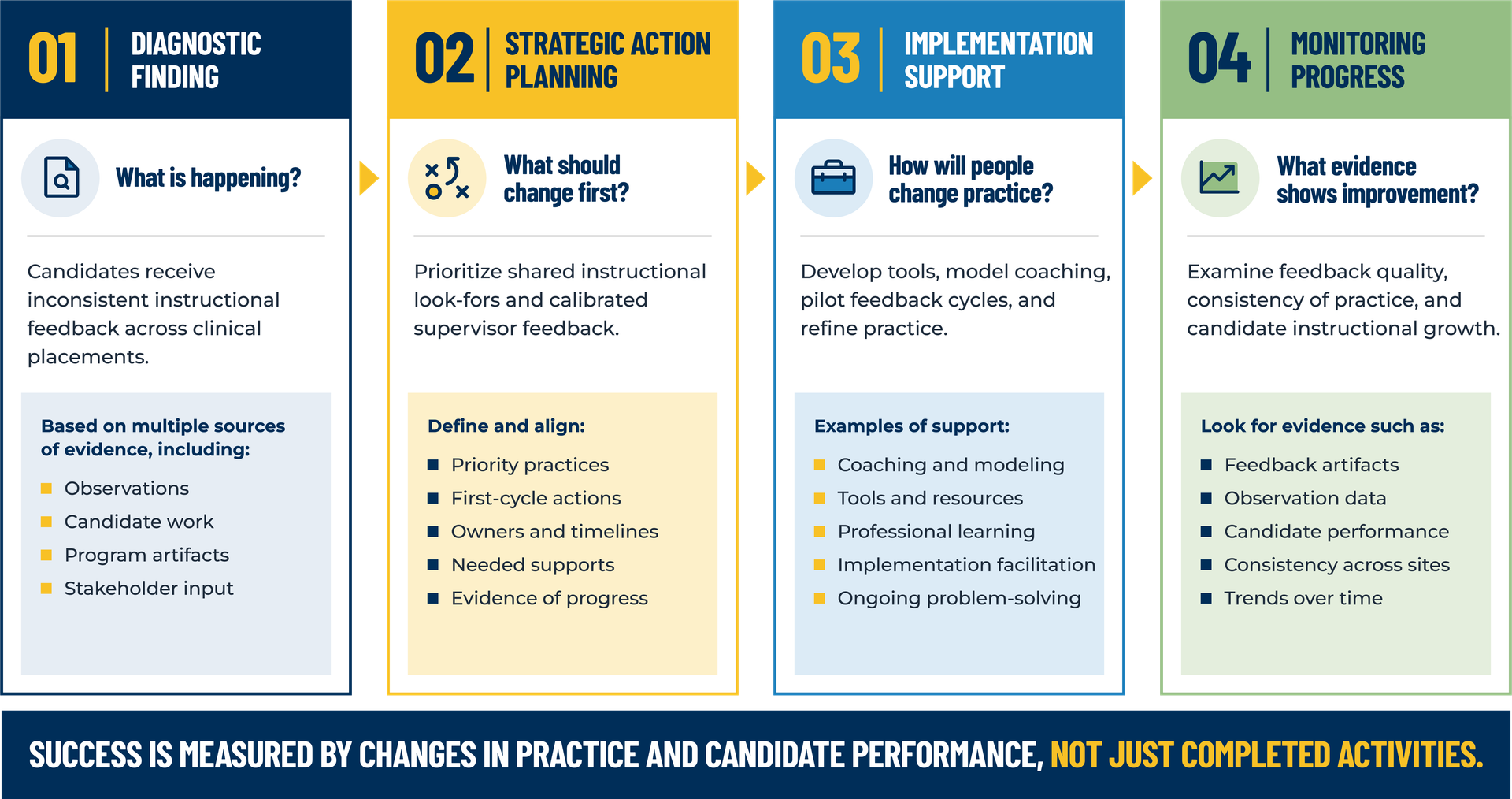
At EdPrep Partners, Strategic Action Planning helps programs translate findings and prioritized recommendations into a focused set of high-leverage changes.
The process is not simply drafting a response to a review. It brings together the people responsible for program improvement to make decisions about what should change and how.
Strong Strategic Action Planning establishes:
- Prioritized Practices: The few changes most consequential for improving candidate preparation and readiness.
- First-cycle actions: What will change in coursework, clinical experiences, teacher educator practice, assessment, or program systems.
- Ownership and sequencing: Who has the authority and responsibility to lead each action, what must happen first, and what existing work can be strengthened or replaced.
- Implementation supports: What professional learning, tools, coaching, resources, or technical assistance will be necessary.
- Evidence and monitoring: How the program will determine whether changes are occurring with quality and whether candidate performance is improving.
These decisions should reflect the program's context, capacity, and locus of control.
The resulting Strategic Action Plan belongs to the program. The technical assistance plan should then organize external support around those program-owned priorities.
That distinction matters. Programs must lead and sustain improvement. Technical assistance should help them develop the capacity to do so.
From Recommendations to Changes in Practice
Consider a review identifying inconsistent coaching and feedback across clinical placements.
A broad recommendation might call for improving clinical supervision.
A focused Strategic Action Plan would go further.
The program might prioritize establishing shared expectations for a small set of instructional practices, revising observation and feedback tools, and calibrating clinical supervisors and mentor teachers against common evidence of candidate performance.
The first implementation cycle could involve piloting those practices with selected supervisors and candidates, examining actual feedback records, observing coaching conversations, and reviewing evidence of candidate enactment.
Technical assistance could provide initial tools, model coaching practices, facilitate calibration, support implementation, and help the program refine its approach before expanding.
Importantly, progress would not be measured only by whether a new rubric was created or training occurred.
It would be examined through the quality and consistency of coaching, the developmental opportunities candidates receive, and evidence of increasingly proficient instructional practice.
This is what it means to move from recommendations to implementation.
States Can Build Systems That Support Both
Examples are already emerging in educator preparation.
In Delaware, the Department of Education has connected statewide Science of Reading expectations with Literacy Program Performance Reviews, Strategic Action Planning, and targeted technical assistance. The approach is designed to help programs move from findings toward prioritized changes in coursework, clinical experiences, teacher educator practices, and candidate literacy readiness.
In Michigan, the Michigan Educator Preparation Program Collaborative, led by the Michigan Educator Workforce Initiative in partnership with EdPrep Partners and 2Revolutions, connects Deep Dive Program Reviews with institution-specific Strategic Action Planning and sustained technical assistance. Programs are advancing different priorities based on their evidence and context, including instructional frameworks, candidate developmental trajectories, practice-based coursework, coaching, and data routines.
Both initiatives demonstrate approaches to connecting evidence with implementation support. Their longer-term effects on candidate readiness and P-12 outcomes will need to be assessed as implementation progresses.
The larger opportunity is for states to establish improvement processes in which accountability findings inform strategic decisions, investments, and ongoing support.
That includes recognizing that programs differ in their readiness to implement change. Some have strong internal leadership, shared expectations, and implementation capacity. Others need additional support to establish those conditions.
Technical assistance should respond to those differences rather than assume every program needs the same intervention.
Connecting School Improvement and Educator Preparation
This approach also creates an opportunity to connect the instructional improvement priorities states are pursuing in schools with the preparation of future teachers.
States are investing in evidence-based literacy instruction, mathematics improvement, high-quality instructional materials, and stronger coaching and feedback.
Those investments should inform what candidates are expected to know, practice, and demonstrate before entering classrooms.
Alignment does not require every preparation program to mirror a particular district or instructional model. Candidates must develop the knowledge, instructional judgment, and adaptability to teach effectively across contexts.
But states can establish clearer connections among instructional expectations, preparation quality, candidate readiness, and the support provided to programs.
When schools are expected to improve instruction, the preparation of future teachers should be part of the improvement strategy.
What State Leaders Can Begin in the Next 90 Days
States do not need to redesign their entire accountability systems to strengthen the connection between oversight and improvement.
Days 1–30 | Clarify the expectations. State educator preparation and school improvement leaders can select a priority instructional area and map the associated expectations for preparation programs. Produce a concise statement of what candidates should be prepared to know and demonstrate.
Days 31–45 | Examine diagnostic quality. Review a small sample of recent program reviews. Determine whether findings are grounded in representative evidence of actual preparation practices, distinguish compliance from quality concerns, and identify the highest-leverage changes. Document gaps in review methods and reporting.
Days 46–60 | Pilot Strategic Action Planning. Convene program leaders and implementation stakeholders around a limited set of findings. Identify one to three priority shifts, initial actions, owners, milestones, capacity needs, and evidence of progress. Produce a focused Strategic Action Plan and identify which actions address regulatory requirements separately.
Days 61–90 | Align support and monitoring. State leaders, programs, and technical assistance partners can determine the supports needed for each priority, identify available funding and capacity, and establish a regular implementation review schedule. Monitoring should distinguish completion of required actions, evidence that practices are changing, and emerging evidence of candidate growth.
These steps can begin within existing approval, review, partnership, and funding structures.
The goal is not another layer of requirements. It is a more effective use of the expectations, evidence, resources, and relationships states already have.
The Preparation Side of Accountability
Strong educator preparation accountability should protect quality, identify where improvement is needed, and help ensure that meaningful changes follow.
That requires credible diagnostics, prioritized action, institutional ownership, implementation capacity, and sustained attention to results.
A program can meet regulatory requirements and still have important work to do to strengthen candidate readiness. A program can also have promising instructional practices while failing to meet essential state requirements.
An effective accountability system must respond appropriately to both.
Bellwether's discussion offers an important opportunity to rethink what happens after schools are identified for improvement.
We should bring the preparation of future teachers into that conversation.
Because the responsibility to improve instructional quality should not begin when a teacher enters the classroom.
Every child deserves an excellent educator. Let's give them one.
Stay Connected
If you're interested in learning more, exploring collaboration or technical assistance, or just want to catch up, we’d love to connect:

About EdPrep Partners
Elevating Teacher Preparation. Accelerating Change.
EdPrep Partners is a national technical assistance center and non-profit. EdPrep Partners delivers a coordinated, high-impact, hands-on technical assistance model that connects diagnostics with the support to make the changes. Our approach moves beyond surface-level recommendations, embedding research-backed, scalable, and sustainable practices that most dramatically improve the quality of educator preparation—while equipping educator preparation programs, districts, state agencies, and funders with the tools and insights needed to drive systemic, lasting change.