
More Time to Strengthen Teacher Preparation
State agencies make important decisions about educator preparation. They determine whether proposed programs meet state requirements and whether existing programs may make changes to their approved models.
State agencies determine whether new educator preparation programs meet requirements to launch and whether existing programs can modify their approved models. These decisions influence how quickly programs can respond to workforce needs, expand certification pathways, and implement improvements to candidate preparation.
The application process behind each decision requires considerable coordination. State staff collect documentation, determine which requirements apply, assign reviewers, communicate requests for additional evidence, track revisions, and document decisions.
When these responsibilities depend on separate spreadsheets, folders, emails, and manual follow-up, staff can spend substantial time managing paperwork and checking application status.
That is time they could spend answering program questions, explaining requirements, and supporting preparation improvements.
States should not have to choose between rigorous oversight and efficient approval processes. Well-designed systems should make both possible.
Different Applications. Requirements That Fit.
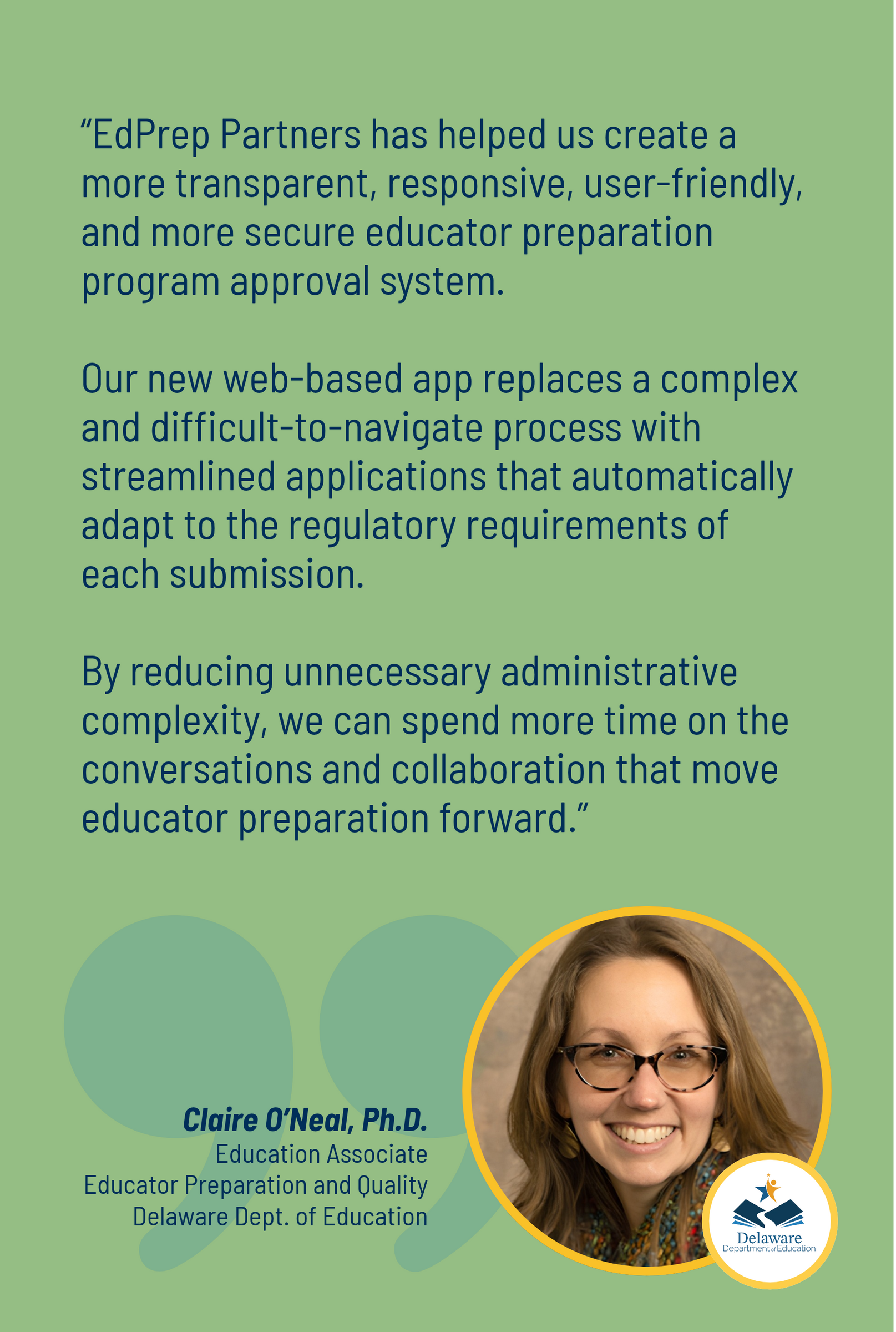
Through our partnership with the Delaware Department of Education, EdPrep Partners helped redesign application guidance, reviewer processes, and end-to-end workflows. We also supported the development and implementation of a centralized digital system for managing new program approvals and modifications.
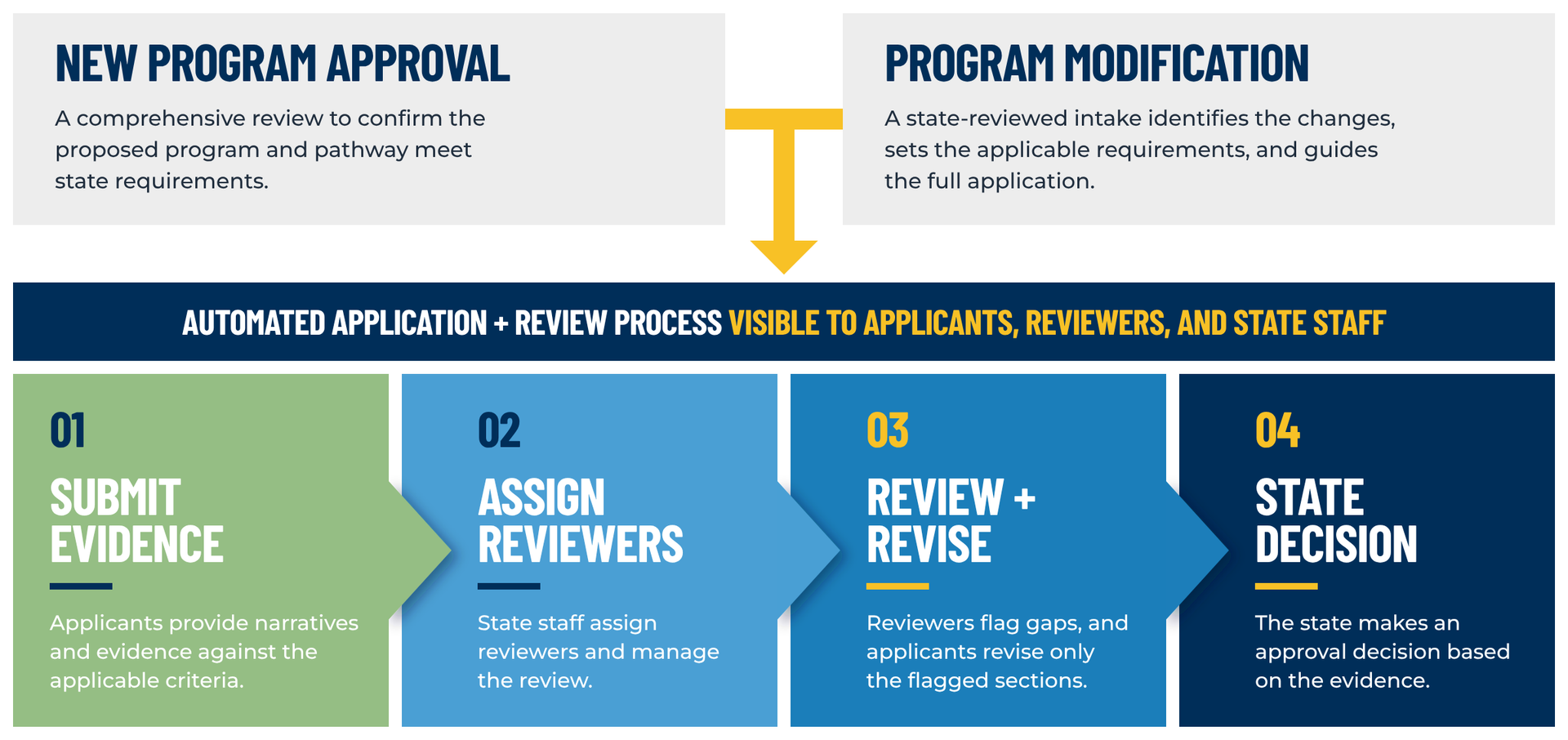
For program modifications, the process begins with intake questions about the changes a program proposes. DDOE reviews the intake request before the applicant proceeds to the full application. Based on those responses, the web-based system tailors the application and provides specific, preprogrammed guidance on how to address the provisions of Delaware law and regulation that apply to the proposed changes.
A new traditional preparation program may need to demonstrate that it meets a comprehensive set of regulatory requirements. An alternative certification program may have different requirements. A program seeking to modify an existing approval may need to address only the criteria related to its proposed changes.
The system presents the applicable requirements and allows programs to submit narratives and supporting evidence against specific criteria.
State staff manage application intake, assign reviewers, and track progress. Reviewers examine the evidence and identify where clarification or additional documentation is needed. If an initial intake request needs revision, the applicant submits a new intake. Once a full application has been submitted for review, applicants can revise the specific sections flagged for additional evidence or clarification without resubmitting unchanged sections.
The status of each application is visible to applicants, reviewers, and state staff, while automated communications help clarify what needs attention and who is responsible for the next step.
These features are designed to reduce unnecessary exchanges, repeated documentation requests, and administrative delays while maintaining rigorous review requirements. The state retains responsibility for interpreting its requirements and making approval decisions.
A STREAMLINED, STATE-LED PROCESS:
LESS TIME MANAGING APPLICATIONS.
MORE TIME STRENGTHENING PREPARATION.
Giving Time Back to States and Programs
The potential benefit extends well beyond processing applications.
State agency staff can spend less time locating documents, following up with reviewers, and communicating routine status updates. They can devote more attention to helping programs understand new requirements, discussing proposed changes, answering questions, and providing guidance.
Programs benefit from clearer evidence expectations, documented feedback, and better visibility into their application's status and next steps.
Consider a program seeking approval to add a certification area where local schools need more teachers. A lengthy approval process can delay recruitment, staffing, and the launch of a new pathway.
Or consider an existing program seeking approval to revise its clinical experience structure. Delays can affect when faculty, supervisors, and district partners begin implementing those changes.
Making the administrative process more efficient helps programs plan and act sooner.
For EdPrep Partners, that is the purpose of this effort. We want program leaders and teacher educators to have more time and resources to strengthen coursework, clinical experiences, coaching, feedback, and the preparation candidates receive.
Less time managing applications means more time available to support the people and practices that prepare future teachers.
What States Could Do Next
The same design principles may also be useful for other state regulatory responsibilities, including continuing approval and reauthorization processes. Those applications would require their own criteria, evidence expectations, and review procedures.
State agency leaders can begin by tracing one recent new program application and one modification from initial intake to final decision.
Map who acted at each stage, which requirements applied, where clarification was needed, and when the process stalled. Then distinguish responsibilities requiring regulatory interpretation and professional judgment from routine activities such as document routing, status tracking, and notifications.
Use that analysis to prioritize two or three changes to application guidance, reviewer processes, or digital workflows. Establish how the agency will determine whether those changes reduce administrative burden while maintaining the quality and rigor of its reviews.
At EdPrep Partners, we envision state agencies with the time and tools to uphold rigorous expectations while serving as active partners in strengthening educator preparation.
Faster, clearer decisions can help programs respond to changing requirements, expand pathways, and implement improvements sooner.
And the time gained can be directed toward a responsibility we all share: preparing teachers who are ready to support student learning from day one.
Every child deserves an excellent educator. Our state systems should help make that possible.
Let's make teacher preparation better together.
Related EdPrep Insight
The state application and approval processes discussed here are distinct from EdPrep Partners' Program Performance Reviews, which examine how preparation operates in practice and identify priorities for improving candidate readiness.
Learn more in Beyond the Review: Where Reports End and Results Begin.
Stay Connected
If you're interested in learning more, exploring collaboration or technical assistance, or just want to catch up, we’d love to connect:

About EdPrep Partners
Elevating Teacher Preparation. Accelerating Change.
EdPrep Partners is a national technical assistance center and non-profit. EdPrep Partners delivers a coordinated, high-impact, hands-on technical assistance model that connects diagnostics with the support to make the changes. Our approach moves beyond surface-level recommendations, embedding research-backed, scalable, and sustainable practices that most dramatically improve the quality of educator preparation—while equipping educator preparation programs, districts, state agencies, and funders with the tools and insights needed to drive systemic, lasting change.