EdPrep Partners Quarterly Update - Winter 2025
EdPrep Partners Quarterly Update
Winter 2025 | From Design to Practice. What Works at Scale.
What We’re Designing For
As one year comes to a close and another begins, many educator preparation programs and system partners are taking stock of how their work is showing up in practice. Across the field, there is real momentum around strengthening preparation, alongside a growing recognition that progress depends on whether effective teaching practices are intentionally built into candidate preparation and show up consistently in P-12 classrooms.
That recognition sits at the center of EdPrep Partners’ work.
We focus with our partners on preparation that results in consistent candidate readiness, not isolated bright spots. That requires attention to the systems that shape daily teaching & learning: the opportunities candidates have to practice the work of teaching, the ways teacher educators model and coach those pedagogies, and the degree to which expectations and feedback are aligned across coursework and clinical experiences. When those elements are intentionally built into the design of the preparation program, improvement is more likely to hold as programs scale, staffing changes, and contexts shift.
Design, in this sense, is concrete. It shows up in whether candidates have sustained opportunities to move from analyzing teaching to rehearsing and enacting it. It shows up in whether faculty and clinical supervisors share clear instructional expectations and provide feedback that supports improvement. And it shows up in whether evidence is used routinely to guide decisions over time, strengthening both teacher educator practice and candidate learning.
Over the past quarter in the bodies of work we have the privilege of supporting, we have seen programs and states increasingly centering the work on a common set of fundamentals: clarifying what strong practice looks like, narrowing priorities, strengthening teacher educator practices, and building routines that connect evidence to action. The progress emerging from these efforts reflects a shared understanding that durable improvement comes from doing fewer things with greater intent and building systems that support consistent execution.
This quarterly update reflects that focus. It includes a synthesis of emerging patterns in how preparation improvement work is taking shape, highlights from organizations and research informing our thinking, a recap of recent EdPrep Insights, and a look ahead to where our work will deepen in the months ahead.
We are grateful to the preparation leaders, faculty, clinical supervisors, district partners, and state teams engaging in this work with care and a serious attention to what we know works. When preparation systems are built with clarity and discipline, candidates are better prepared to enter classrooms ready to teach and contribute meaningfully to P-12 student learning from day one.
Let’s make teacher preparation better together.
Calvin J. Stocker
Founder & CEO, EdPrep Partners
EdPrep Insights: What You May Have Missed
Our EdPrep Insights series brings forward urgent challenges in educator preparation and offers research-aligned, actionable strategies for improvement. Each brief is grounded in our program performance review and technical assistance approaches, and directly reflects the EdPrep Performance Framework and our 14 Levers for Quality Teacher Preparation. If you haven’t had a chance to explore the latest editions, here’s what you’ve missed:
Beyond Access: Preparing Candidates to Teach with HQIM
Across a five-part series, Beyond Access examined what it actually takes for candidates to leave preparation ready to teach with the instructional materials they will be expected to use in P-12 classrooms. The series moved from defining why HQIM must be foundational in preparation to outlining the developmental skills candidates need, the role of teacher educators in modeling and coaching curriculum use, and the program-level systems that make readiness routine rather than incidental.
Read the five-part series here
The Prioritization Imperative
This Insight explored how strong programs avoid dilution by narrowing focus to a small number of high-leverage priorities. It highlights how clear sequencing, shared routines, and disciplined scope allow changes to show up in teacher educator practice and candidate learning, rather than remaining stuck at the planning level.
But Who Develops the Mentors?
One of our most-read Insights this year, this piece revisits a persistent gap in preparation systems: mentor development. This EdPrep Insight reinforces that strong mentoring does not happen in isolation, and is built upstream through faculty and clinical supervisor development. It outlines five concrete actions programs take to support the teacher educators who make effective mentoring possible.
Emerging Patterns in Preparation Improvement
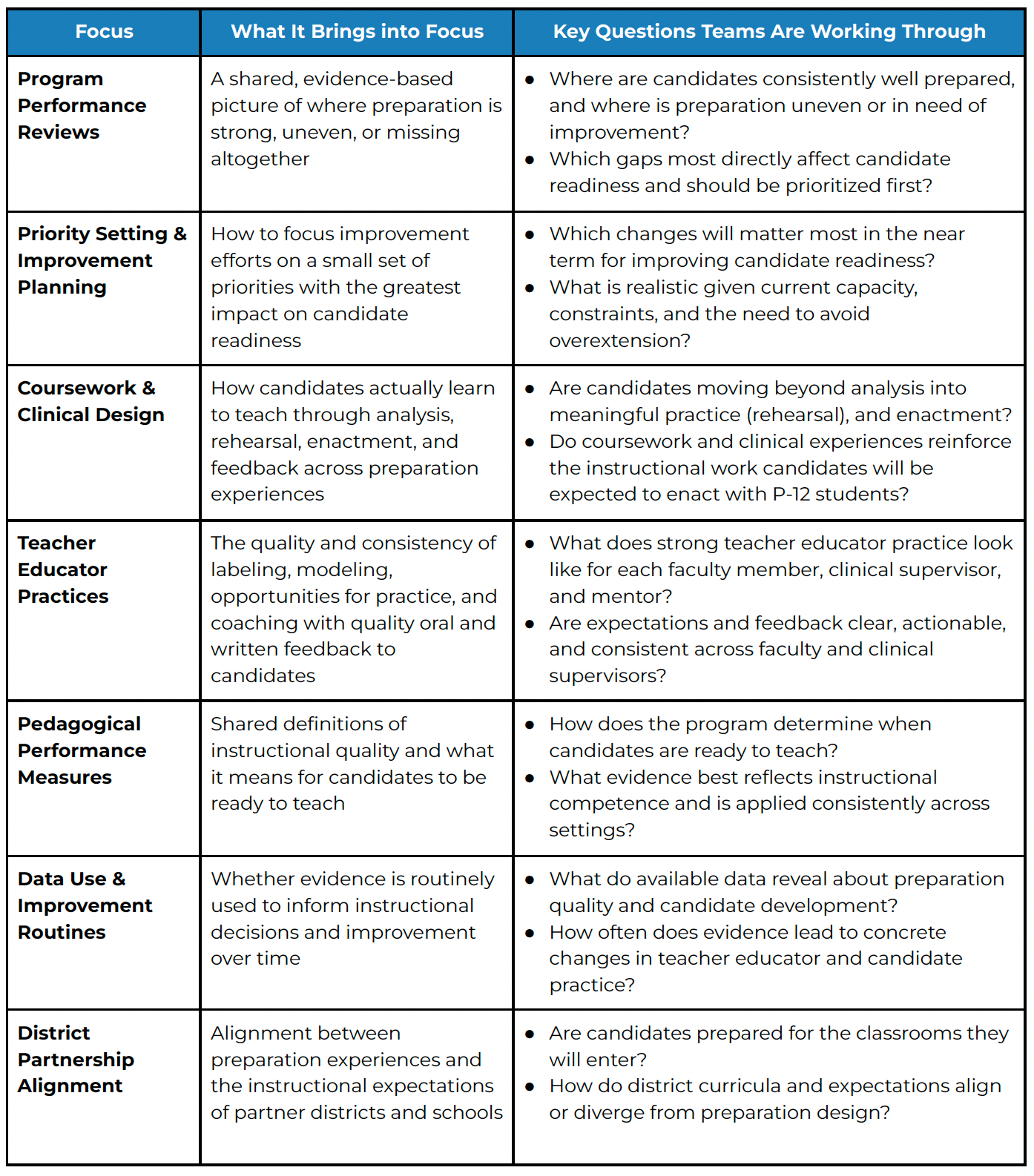
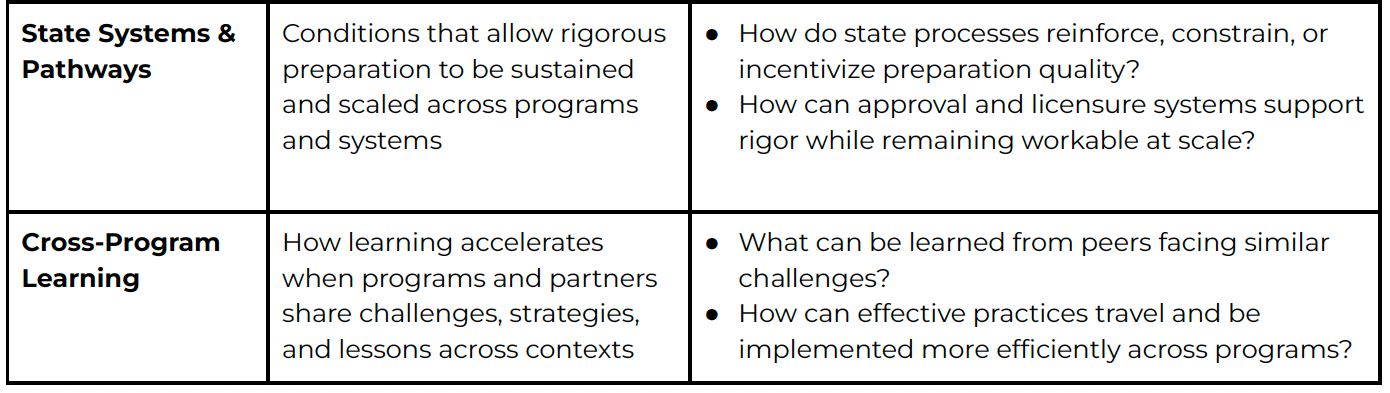
Across our work this year, a set of recurring approaches has surfaced as programs, states, and collaboratives work to strengthen educator preparation. These patterns reflect how our teams and those we have the privilege of supporting are organizing improvement efforts across different contexts. This list is by no means exhaustive or prescriptive; rather, it illustrates common ways the field is approaching durable improvements in teacher preparation.
What We’re Learning From the Field
This quarter, a few efforts stood out to us for how directly they connect instructional improvement to educator practice and system design.
From TeachingWorks at the University of Michigan
The TeachingWorks team recently joined the University of Michigan Marsal Family School of Education’s Innovator Showcase to reflect on what it truly takes to prepare teachers well and at scale.
Francesca Forzani named the central tension many preparation programs face: preparing excellent teachers in the numbers the field requires. Deborah Loewenberg Ball underscored what is often missing in that pursuit – a deep understanding of the actual work of teaching and how candidates learn to do it.
This conversation reinforces a core premise of strong preparation: candidates need repeated, supported opportunities to learn the work of teaching, not just knowledge about it. That focus on practice sits at the center of effective preparation design.
From the Educational Policy Initiative at Carolina (EPIC) at UNC Chapel Hill
EPIC’s evaluation of the Rethink Initiative offers a thoughtful look at how innovation efforts succeed, or stall, based on how deeply they are embedded into instructional systems.
The report highlights the importance of clear instructional focus, sustained implementation support, and attention to educator practice over time rather than short-term pilot outcomes. The findings reinforce what many programs experience firsthand: durable improvement depends less on launching new initiatives and more on designing systems that help educators learn, enact, and sustain strong practice.
Read the final report | View the summary infographic
From the Charles Butt Foundation
Over eight years, the Raising Blended Learners initiative demonstrated how blended and personalized learning can scale across diverse Texas contexts when districts integrate these practices into their core instructional systems.
What began as a demonstration effort ultimately informed statewide policy, supported long-term district implementation, and shaped how blended learning is supported across Texas today. Raising Blended Learners shows that what often gets labeled as “innovation” is frequently strong instructional practice, and is successful when districts (and educator preparation programs) invest in educator learning, align systems, and commit to sustainability from the start.
Explore the impact report and resources
From E3 Alliance
A new E3 Alliance report examining ten years of teacher retention data in Texas highlights stark differences across certification pathways and subject areas.
Teachers entering classrooms without meaningful preparation return at significantly lower rates than those who complete standard or alternative certification pathways with preparation requirements. The data makes a clear case that preparation is not a bureaucratic hurdle – it is a workforce stability strategy. Where preparation is stronger, retention improves.
From the Federal Reserve Bank of Dallas
A recent study from the Federal Reserve Bank of Dallas examines how individuals enter the teaching profession and finds that career decisions are shaped much earlier than preparation systems often assume – frequently during high school and in response to local economic conditions.
The research shows that when local economies weaken, more students consider teaching, and those who do tend to be stronger academically and more effective once they enter classrooms. These findings underscore the importance of early pathways, local partnerships, and preparation systems that align with regional labor markets. Strengthening preparation is not only about program design – it is also about when and how (and when) potential teachers first enter the profession.
What’s Ahead
In the months ahead, EdPrep Partners will deepen our work with state agencies, educator preparation programs, and system partners to support rigorous preparation at scale.
Statewide Networks & Collaborations
We are launching several new, multi-year, statewide collaborations and focused bodies of work aimed at strengthening preparation across groups of educator preparation programs. These efforts are anchored in program performance reviews that generate clear, prioritized recommendations and focus areas, and are paired with targeted technical assistance and cross-program learning.
Across these collaborations, EdPrep Partners supports programs in strengthening teacher educator practices; improving coursework alignment and instructional impact; and refining both coursework and clinical experiences to ensure candidates have sustained opportunities to analyze teaching, engage in representations and rehearsal of core methods and content pedagogies, and enact instruction with high-quality oral and written feedback. This work also supports programs in strengthening data use and routines and deepening district partnerships. Together, these efforts are designed to help teams redesign coursework, strengthen clinical experiences, expand high-quality pathways, and build durable systems that support sustained improvement over time.
Advancing Content-Specific Preparation in Literacy and Mathematics
Alongside our systems-level work, EdPrep Partners will continue to advance content-specific efforts in literacy and mathematics. This work focuses on how candidates learn to develop and apply disciplinary knowledge through instruction, and how teacher educators design, model, and coach high-quality teaching practices across coursework and clinical experiences.
Across both content areas, this work is intentionally connected to program design, teacher educator practice, and data use, ensuring content-specific improvement strengthens preparation systems rather than operating as isolated initiatives.
Throughout these efforts, our focus remains consistent: supporting programs to align educator practice, program design, and system-level conditions so candidates enter classrooms prepared to teach and contribute meaningfully to P-12 student learning from day one.
More to come in the new year.
Stay Connected
If you're interested in learning more, exploring collaboration or technical assistance, or just want to catch up, we’d love to connect:

About EdPrep Partners
Elevating Teacher Preparation. Accelerating Change.
EdPrep Partners is a national technical assistance center and non-profit. EdPrep Partners delivers a coordinated, high-impact, hands-on technical assistance model that connects diagnostics with the support to make the changes. Our approach moves beyond surface-level recommendations, embedding research-backed, scalable, and sustainable practices that most dramatically improve the quality of educator preparation—while equipping educator preparation programs, districts, state agencies, and funders with the tools and insights needed to drive systemic, lasting change.